Purple Power
One of the great features — and there are many to choose from — about Polly Gasston Jewellery is our use of semi-precious stones. They are not always cheap by any means, but they go so perfectly with the yellow metal, and quite a plain stone can be lifted to new heights by 22ct gold. One stone that ticks all the semi-precious boxes is amethyst, and it is one we use regularly and always seem to have in stock. But it has not always been cheap and plentiful.
Ancient Beliefs and History
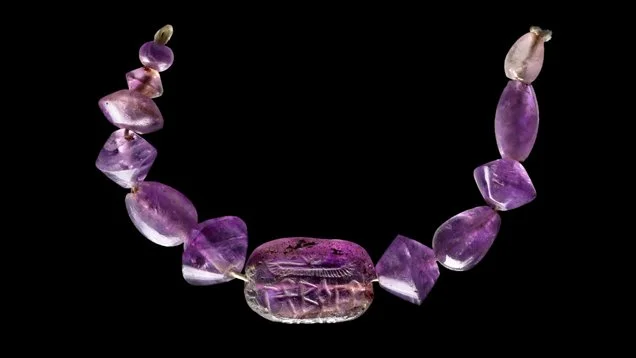
The word amethyst comes from the ancient Greek amethystos, which means not intoxicated — because the Greeks really believed that if you carried a piece of amethyst on you, you would be safe from intoxication. They even carved goblets from amethyst to ward off drunkenness. I cannot imagine how they came to this conclusion, but the idea must have started somewhere! The ancient Egyptians used amethyst too, making beads and carving amulets. Roman and Anglo-Saxon soldiers alike carried it for protection, and in Tibet it has been sacred throughout all history.
Until the 19th century, really high-quality amethyst was rare and precious, and was one of the cardinal gems along with ruby, sapphire and emerald — the special preserve of royalty and the otherwise rich and important, like church leaders. Interestingly, some sources say that bishops wear an episcopal ring with amethyst alluding to not drunk at Pentecost, and others say it is because the amethyst was extremely precious and therefore right for such elevated members of the church. I think either is quite possible! And legend has it that St Valentine wore a ring with an amethyst stone carved with Cupid's head — presumably nothing to do with warding off drunkenness but more to do with the properties of keeping calm and being peaceful. An apt stone for the February birthstone, anyway.
From Siberia to Brazil
The most expensive and desirable stones were mined in Russia — the most precious of these being Siberian amethyst, which is a deep reddish-purple. Even though not much comes from there any more, that colour of amethyst is still called Siberian. Then in the 19th century amethyst was found in Brazil, in abundance, and the value dropped dramatically. Now amethyst is mined all over the world — North America including Canada, South America, Africa, Europe, Russia and Asia — and in very large quantities. From Zambia alone, about 1,000 tonnes a year are produced.
The reason it is found all over the world is because it forms in volcanic ground and igneous rock, and just about everywhere on earth has one or other of these features. Volcanic regions produce amethyst in geodes — sort of bubbles of rock that, when broken open, are lined with amethyst crystals, some large enough for a person to stand up in. In igneous rock it can be found in a vein, which can produce enormous chunks or thousands of little crystals. As I said, the most precious is the very dark purple, especially with red lights in it.
Some marketing genius, probably from one of the big jewellery houses, christened some very pale, almost pink amethyst Rose de France — and voilà! Pale amethyst became a must-have gem.
Colour Zoning and Ametrine
Another colour feature of amethyst is called colour zoning, which means that the crystal has different sections of colour within it. In the 1990s the now most famous of this colour-zoned amethyst was discovered in Morocco, where crystals were found containing purple and clear crystal almost in stripes. The crystals are renowned for being beautifully formed and, with some additional polishing and shaping, are positively dramatic.
Amethyst is not just different shades of purple by any means. Citrine is actually heat-treated amethyst, and there is also a stone called ametrine — a combination of amethyst and citrine — which occurs naturally when an amethyst crystal is subjected to different levels of heat during its formation. This results in one part of the crystal being purple and the other, differently heated part being yellow.
Green Amethyst and Prasiolite
There does not appear to be any controversy about what citrine actually is, compared with the argument that surrounds green amethyst. It seems that if someone tells you they are selling you a green amethyst, they are not lying — they are just trying to sell you something for more than it is worth, probably. If it is a crystal and it is green and it is very expensive, it should be called prasiolite, which is indeed a quartz crystal but very rare. Found in Brazil originally and almost completely mined out, it is widely substituted with heat-treated amethyst, which of course is not worth a small fortune at all.
Normally when amethyst is heated it goes yellow — as in citrine — or even orange, and sometimes it goes very pale mauve. But in some amethyst, due to its chemical structure, heat treatment will turn it a pale green, which is very beautiful but not very precious after all. Unfortunately this is another stone that the layman will be hard-pressed to distinguish from the real thing.
But magpies do not care about being royalty or heat treatments. Whether it is rare and valuable or cheap as chips, if it is lovely and they want it — oompa loompa!