Prehistoric Chic
In my history box, which is full of interesting things from my grandparents mostly, I found this photograph of my grandmother, taken about 100 years ago in Entebbe. That is my mother, aged about three, in all her little bare-foot glory. But the other thing that is so important about this photo is the necklace my grandmother is wearing — a long string of amber, highly fashionable at that time. Amazingly, the second photograph, taken on my workbench yesterday, is of this very necklace. I have been aware of this necklace and photograph my whole life, but I have never until now really thought about amber and what its story is.
What is Amber, Exactly?
We all know that amber is the resin from certain pine trees, but because it was first found washed up on beaches, this connection to trees was not made for many thousands of years. Nicias (470–413 BC) declared that amber was created by the rays of the setting sun hitting the land with such strength that it left an unctuous sweat that was then washed into the sea on the tide. The Greeks got a bit closer to the truth with their myth that when Phaëton, the son of Helios (the Sun), was killed, his sisters turned into pine trees and their tears turned into elektron — amber. But it was really the Roman naturalist Pliny who knew amber was tree resin because, he said, it smelled of pine trees when rubbed and it was combustible. Clever deduction.
The interesting thing for me in all this conjecture is that amber was found, first and foremost, on the beach, which really required some explaining. It seems that millions of years ago the pine trees that produced the resin would, during massively heavy rains, fall over, and along with all the resin they had produced that had fallen to the ground, they would be washed into the rivers and then into the sea, where they were covered with sediment which then hardened. When mountains formed, this rock was pushed up, releasing the amber, which would eventually wash up on the beaches.
There was still confusion over what it was and what to call it. Because what we know as ambergris (from sperm whales) was also found on the beaches, and as both these strange deposits had a distinctive and not unpleasant smell, for a long time the only distinction was to call one yellow amber and the other grey amber (ambergris). Eventually, as their origins and uses were more clearly understood, yellow amber became simply amber and ambergris kept its name. Interestingly, going back to the Greek myth in which the sisters' tears were called elektron (beaming sun), this gave rise to the word electric because of amber's ability to bear an electric charge.
Where Amber Comes From
Amber is found almost the world over, but by far the greatest deposits are mined inland in what was Prussia, and from its coastline on the Baltic Sea. Even now, 90% of the mined amber comes from the same region, which will continue to produce amber for another 300 years if it is mined at the same rate as today. What an enormous forest must have been there once. In fact, there is so much amber and it was such an important part of Prussian culture that in 1712 King Frederick of Prussia had an entire banquet hall made with amber panels.
In North America, amber is mined in open pits in Arkansas, and in Asia it is extracted from coal mines. The amber now being mined in Myanmar is of such high quality that mostly it goes to museums. Also snapped up by museums, for obvious reasons, are pieces of amber that are found with inclusions — small insects, leaves and feathers — things that got caught in the amber when it was still liquid but from which they could not escape. Jurassic and even older mosquitoes and ants have been found in amber, and they play a vital role in piecing together what was happening on earth at that time.
Blue Amber — The Rarest of All
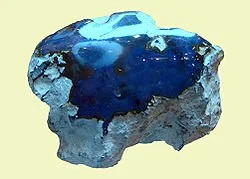
By far the most precious amber is blue amber — who knew it even existed! It comes mostly from the Dominican Republic, with some found in Mexico and Indonesia, but the Dominican Republic blue amber is the real deal. Not only is it very rare, but it is the only amber that is fluorescent. In sunlight the amber appears blue; in artificial light it is browny-yellow like any other amber. It is the resin of a now-extinct tree, hymenaea protera or the Algarrobo tree, and is thought to have been formed 15–20 million years ago. The reason it is blue is not certain, but it is supposed to be the result of incomplete combustion during forest fires. Amazing, and something to be sought out, I think!
Grades, Clarity and the Necklace
Amber comes in all grades. Bastard or bony amber is cloudy because it is full of tiny air bubbles. This and dirty amber, which has inclusions of dirt and fragments of twigs and leaves, are mostly ground up and used either for incense — one of its most ancient uses — for smoking paraphernalia, and for varnish. The clear, quality amber is used in jewellery, but some of this clear amber may have been clarified by being heated in linseed oil, which softens it enough to release inclusions or air bubbles. Interestingly, two pieces of amber can be joined by rubbing the surfaces with linseed oil, gently heating the amber and pressing them together. If I had two pieces with which to try, I would!
I looked very carefully at the beads in my grandmother's necklace and, while some are quite clear and lovely, others are bony amber. Amazingly, none of the beads has dried out and cracked, which is also quite common in old amber beads and other artefacts.
For a magpie, amber can be a bit of a conundrum: magpies eat insects and magpies love jewels — so what to do when there is an insect in a jewel?