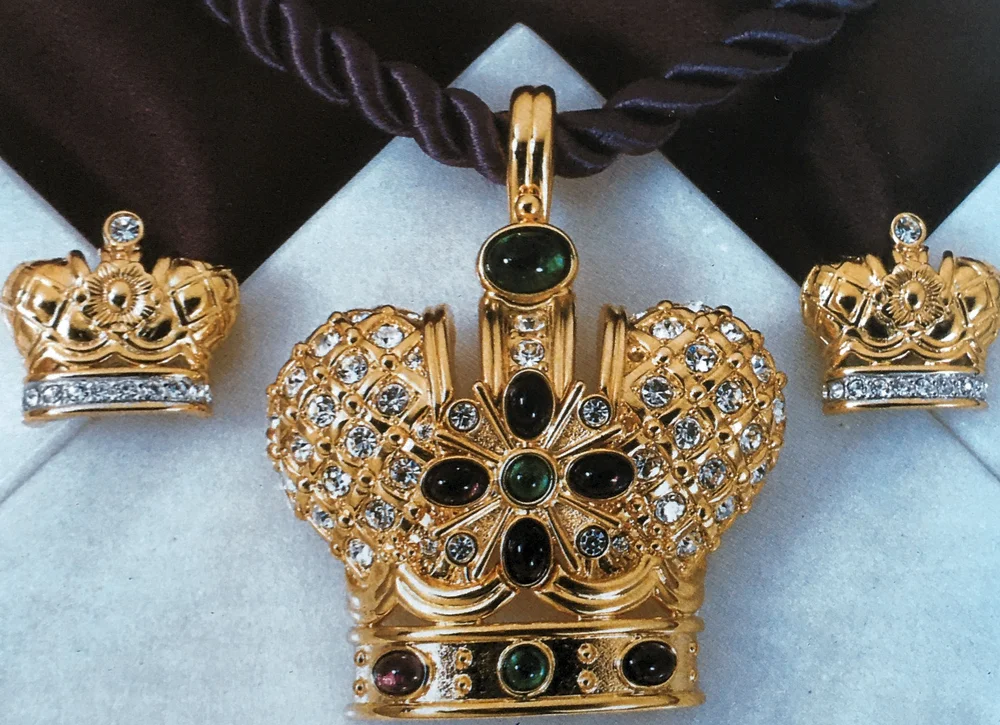
A Gallop Through the Centuries
A while ago I had to wait ages for a particular new piece of jewellery — but this time it was costume jewellery. How can this be, you cry! Well, Polly had a pair of costume jewellery earrings that she absolutely loved, so she had them copied in gold and with real gems — peridot and pearls — and I inherited the faux pair because I love them too. In anticipation of the new jewels, I started reading about costume jewellery, and saying I will tell you all about it in one article is like saying I will explain the universe in one sentence. So instead, I will take you on a gallop through the centuries and hope it is a fun ride.
The Origins of Imitation Jewellery
Imitation jewellery — as opposed to fake, but more about that later — has always been around. As far back as Egyptian times, imitation gems have been manufactured in glass. In 1565, a rosary maker dropped some beads in a bowl of water where he had been scaling fish. When he took them out he saw that the beads had taken on a pearlescence, and this clever chap went on to figure out how to extract that pearlescence from fish scales and make shiny beads!
Then race ahead to the 18th century, which is the proper advent of costume jewellery, when paste was perfected and gems of all colours — particularly diamonds — could be made, cut and set properly, cleverly emulating the real thing that so few could afford. At the same time it gave jewellers the freedom to experiment with cut and design in ways they would never have been able to afford with real gems and precious metal.
The first commercial paste was made in Bohemia, but it was not as bright and glittery as diamonds, so to enhance its appearance paste stones were foiled on the back with wafer-thin sheets of bright metal — either copper or silver. Because these would tarnish if exposed to the elements, a whole new way of setting stones became necessary, and jewellers perfected very tight, close settings to prevent discolouration behind the stones. As there was no industrialisation back then, costume jewellery was made by traditional jewellers, making this innovation a valuable addition to their already considerable skills.
Pinchbeck, Steel and the Rise of Substitutes
Because of this surge in popularity and affordability, the trade evolved rapidly. In the 18th century, Christopher Pinchbeck, a clockmaker, invented a substitute for gold by combining zinc and copper. It looked like gold, was easily worked, and went very well with paste. At about the same time, a steel worker called Matthew Boulton combined cut steel with marcasite; the jewellery was finely made, highly polished and the marcasite glittered as brightly as diamonds. He produced such fine work that Queen Charlotte wore it — but it was still costume jewellery and affordable.
In 1813, wealthy Prussians were encouraged to turn in their gold jewellery to help fund the uprising against Napoleon, and in return they were given a small piece of Berlin ironwork — like a ring or a brooch. The ironwork quickly came to symbolise patriotism and its popularity grew rapidly. My grandmother gave my mother this Berlin ironwork necklace, and it is a pity this fashion was so short-lived — it is wonderful work.
On the other side of the war coin, Napoleon's Joséphine was single-handedly responsible for reviving the jewellery trade in France. She loved her jewels and insisted on wearing them, but the war had tightened belts and the only way ladies could keep up with Joséphine was to have her jewellery copied — which they did. An additional reaction to the bleakness of war was the appeal of sentiment. A lock of hair or a portrait of a loved one was often included in jewellery, and tokens of love abounded. Stones in a ring might spell a sentimental message: ruby, emerald, garnet, amethyst, ruby, diamond — REGARD.
The Victorian Era and the Rise of Plastics
By the 19th century, costume jewellery was a full-blown industry, and by the Victorian era it was being mass-produced and everyone was involved. I discovered that the Suffragette colours of green, violet and white — which translated into brooches and pins made with peridot, amethyst and pearl — also stood for Give Votes to Women. Who knew?
Another interesting thing I discovered is that René Lalique of wonderful glass fame was actually a jewellery designer first and foremost, and was probably one of the best goldsmiths in Paris in the Art Nouveau period. But Art Nouveau was shunned by the influencers in England, who steered fashion towards the less racy Art Deco style — greatly influenced by Picasso — resulting in cubist and linear designs they thought more appropriate and acceptable.
And this was the era when plastics were coming into their own. First was celluloid in 1900, but this was so flammable that it was deemed a bad idea for jewellery. Then came galalith, made with formaldehyde and a sour milk derivative. And then finally bakelite was discovered, quite by accident in a garden shed by a home chemist — strong, bright, carveable, versatile and not flammable. Obviously it took over the market. This really was the advent of cheap and cheerful jewellery, made to suit the fashion of the day and discarded the moment that fickle fashion changed.
War, Coco Chanel and the Modern Era
Wars inevitably have a huge effect on luxuries, and once again fashion in costume jewellery changed more out of necessity than desire. Women's clothing became more minimal and austere, mostly because of the shortage of desirable fabric, so women brightened up their rather dull clothes with costume jewellery. Paste could no longer be brought in from Czechoslovakia or Austria, so wartime jewellery was more metal than stones — silver in particular — and it was now that vermeil was invented: silver plated with gold.
When the war was over and paste could be imported again, the pendulum swung the other way and costume jewellery went right over the top — huge and plentiful, with very obviously faux stones like brightly dyed pearls, and enough for everyone. But it was an overreaction to the austerity of war and was short-lived, and very quickly costume jewellery went back to being better made, with better stones, better design and more care and class.
Another change in direction came when Coco Chanel hit her stride. She decided that a piece of jewellery should be a deliberate part of an outfit — the finishing touch — rather than just an accessory. Her clothes were classic and minimal and she designed jewellery deliberately for each outfit. But not everyone wanted Coco Chanel, which was quite exclusive anyway. Costume jewellery was being mass-produced to quite a high standard in both England and America, and the leaders in fashion decided that catering to the young was the way forward.
French designer Emmanuelle Khanh said haute couture is dead in 1964, and designers like Mary Quant and Pierre Cardin obviously agreed, focusing directly on the young mass market. Materials like acrylic and plexiglass flooded the shops. With mass production came mass communication — magazines, television, movies, global news — all spreading the word, and very quickly image was everything. Fashions changed season by season, and costume jewellery could follow and indeed set the trends for each new fashion.
Then in the 1970s the hippy handmade look filled the shelves, but in the 1980s costume jewellery enjoyed a revival of glamour and glitz — perhaps in reaction to the throwaway 1960s and the hippy 1970s, but also because women were no longer a novelty in the boardroom and they needed power jewellery to go with their power jobs. What better way to express your individuality than with a bit of faux glitz on your expensive and elegant suit?
Faux vs Fake
At the beginning of this article I mentioned fake jewellery — let me explain. Jewellers who produced good costume jewellery — faux jewels — quite quickly became very wealthy and sought after, and so their work was copied, stamped and sold as the real thing. Effectively, they were fakes of fakes! This makes it very difficult for collectors, because not only did many jewellers not sign their pieces, or they signed some and not others, or they had several makers' marks, but then along came the knock-offs to muddy the waters further.
Infuriating for the designers and frustrating for collectors, certainly — but for a real magpie it does not matter who signed the back or who did not. What matters is that it glitters, and if you want to mix it with your real gold and gems, you must — because that is the essence of being a real magpie.